.png)
What Size Storage Unit Do I Actually Need? A Practical Sizing Guide
What Size Storage Unit Do I Actually Need? A Practical Sizing Guide
Ryan E.
February 9th, 2026
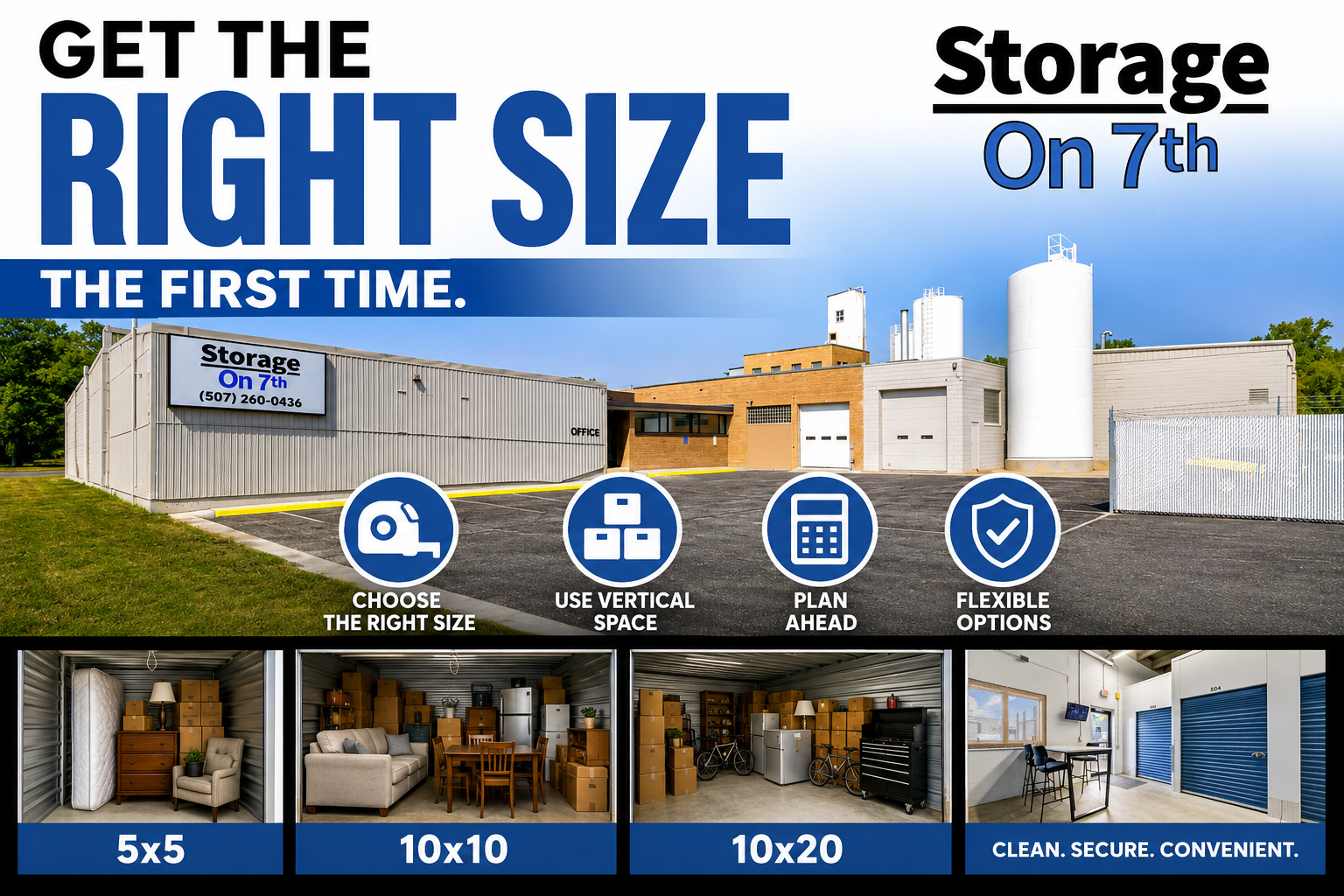
The single hardest part of renting storage isn't picking a facility or comparing prices. It's looking at "5x5," "10x10," and "10x20" on a website and trying to imagine how your couch, your kitchen table, and twenty-three boxes of who-knows-what will actually fit inside. Most people guess wrong. They either pay for a unit that's twice the size they need, or they show up on move-in day to discover their stuff doesn't fit and have to rent a second unit on top of the first. This guide will help you get the size right the first time. I've been running Storage on 7th in Faribault, Minnesota for six years and watched thousands of tenants size up their belongings, so the advice below comes from real patterns, not just a chart.
1. The Bedroom Rule of Thumb (And Why It Works)
If you only remember one thing from this post, remember this: a standard bedroom is roughly 10 feet by 10 feet, which is also our most common storage unit size. So a 10x10 storage unit holds about a bedroom's worth of stuff. From there, you can scale up or down:
- A 5x5 is about a quarter the size of a bedroom (think large walk-in closet)
- A 10x10 is about a bedroom
- A 10x20 is about double a bedroom, or roughly a one-car garage
- A 16x36 is large enough for a whole house's worth of belongings plus a vehicle or two
That mental shortcut alone will get you within one size of the right answer most of the time.
2. A Complete Size-by-Size Guide
Here's a more detailed breakdown of common storage sizes and what realistically fits in each. 5x5 (25 sq ft) — The closetFits about 4 to 6 medium boxes plus a few small items. Good for: seasonal decorations, small furniture (a bookshelf, a side table, a mirror), a few totes of clothes, college dorm leftovers. 5x10 (50 sq ft) — The walk-in closetFits the contents of a small studio apartment, or a bedroom set with no extra furniture. Good for: a mattress and box spring, a dresser, a few boxes, sports equipment. 10x10 (100 sq ft) — The bedroomFits about one to two rooms of furniture, or roughly half a one-bedroom apartment. Good for: a bedroom set, a small living room, kitchen items, plus 10-15 medium boxes. 10x15 (150 sq ft) — The full one-bedroomFits the contents of a complete one-bedroom apartment. Good for: full bedroom, full living room, kitchen, dining room set, plus boxes. 10x20 (200 sq ft) — The one-car garageFits a two-bedroom apartment or small house, or roughly the contents of a one-car garage. Good for: full house furniture, appliances, boxes, and small items, with room to walk around inside. 10x30 (300 sq ft) — The two-car garageFits a three-bedroom house plus appliances and outdoor equipment. Good for: full household contents, vehicles, business inventory, or large equipment. 16x36 (576 sq ft) — The workshop-sized unitOur largest standard size. Fits the contents of a large home plus vehicles, or serves as commercial storage and small business space. Good for: business inventory, classic cars, multiple households of furniture, large equipment.
3. The Vertical Space Most People Forget About
This is the single most overlooked variable in storage sizing. Almost every "what size do I need" guide on the internet talks only about floor area, but storage units have height too. Our units are 10 feet tall. That's a lot of vertical space, and it changes the math significantly. Stacking efficiently can effectively double or even triple how much you can fit in a given footprint. A few rules for taking advantage of vertical space:
- Put heavy, sturdy items on the bottom (boxes labeled "books," dressers, sturdy furniture)
- Stack lighter, more fragile items on top
- Use uniform-sized boxes when possible — they stack much better than a mix of sizes
- Keep an aisle down the middle so you can reach items without unpacking everything
- Don't stack so high that you can't safely move things in and out
I had one tenant who came in convinced she needed our 10x20. She had what she described as "way more stuff than I thought I had" from a recent move. To play it safe, we put her in the larger unit on move-in day, told her to fit everything first, and then we'd figure out the right size from there. She came back the next day, laughing, saying it had been like a game of Tetris. With our 10-foot ceilings she'd been able to stack so efficiently that her stuff actually fit comfortably in a 10x10. We did a unit transfer for her, and the rent she'd already paid on the larger unit carried over as a credit. She didn't pay for her second month at all. The lesson: don't just measure your stuff. Think about how it stacks.
4. Common Furniture and Belongings: How Much Space They Take
To help you visualize, here's roughly how much floor space common items take up before stacking:
- Standard sofa: about 7 feet x 3 feet
- Loveseat: about 5 feet x 3 feet
- Mattress and box spring (queen): about 6.5 feet x 5 feet (can be stood on edge to save floor space)
- Dresser: about 5 feet x 2 feet
- Refrigerator: about 3 feet x 3 feet
- Washer or dryer: about 2.5 feet x 2.5 feet each
- Standard moving box (medium): about 1.5 feet x 1.5 feet, stackable
- Bicycle: about 6 feet x 2 feet
- Standard mattress and bed frame, disassembled: stacks against a wall
If you can mentally pack those items into the floor area of a unit, you've got a workable estimate. And remember: anything you can stand on its end (mattresses, table tops, pieces of disassembled furniture) takes much less floor space than it looks like it will.
5. The Easiest Way to Get an Accurate Estimate
The bedroom rule of thumb gets you close. For a more precise answer, do one of two things: Use a storage size calculator. Most facility websites have one. Ours lets you enter exactly what you're storing — for example, two couches, a queen bedroom set, a dining table with six chairs, a fridge, fifteen boxes — and it tells you what unit size fits and what percent of the unit will be filled. It takes about three minutes and is dramatically more accurate than guessing. Walk through your house with a notepad. Write down every piece of furniture, appliance, and rough box count from each room. Don't trust your memory. People consistently underestimate how much they own when they try to picture it in their heads. Once you have a list, plug it into a calculator or compare it against the size chart above.
6. The Honest "When to Go Bigger" Argument
When in doubt, size up. Here's why: the cost difference between, say, a 10x10 and a 10x15 is usually $30 to $60 a month. The cost of running out of space on move-in day, having to rent a second unit, and then dealing with split storage across two locations is much higher — both financially and in headache. If you're genuinely on the line between two sizes, here's the play I recommend at our facility:
- Take the larger unit on move-in day so you have room to fit everything without stress.
- Once you're moved in, look at how full it actually is.
- If you're using less than 70% of the space, ask the manager about transferring down to a smaller unit.
Most well-run facilities will do a unit transfer for free or for a nominal fee, and any rent you've prepaid on the larger unit will typically carry over as a credit on the smaller one. We've done this for many tenants. It's lower-stakes than people realize. The opposite scenario — starting too small and having to scramble for additional space — is much harder to fix gracefully.
7. What If You Get the Size Wrong After You Move In?
Sizing isn't a one-shot decision at most facilities. If you realize after a month that you have way more space than you need (or way less), you have options. Transferring to a smaller unit. Tell the facility manager you'd like to downsize. They'll find an available smaller unit, give you a window of time to move your stuff over, and apply any unused rent as a credit toward the new unit. Transferring to a larger unit. Same process in reverse. If your business grows or you decide you need to store more stuff, you can move up to a larger unit and have rent prorated. Renting an additional unit temporarily. If you only need extra space for a short period (during a move, while selling a house, etc.), some tenants rent a second smaller unit for a few months and then close it out. The flexibility is built into how month-to-month storage works. The key is to ask. Facility managers do this kind of thing all the time and usually have an unannounced policy of trying to make it easy on you, because they'd rather keep you as a tenant than have you leave for a competitor.
8. Sizing for Specific Situations
A few common scenarios and what tends to fit: Moving from a one-bedroom apartment: A 10x10 to 10x15 is usually right. Moving from a two-bedroom apartment or small house: A 10x15 to 10x20 is usually right. Moving from a three- or four-bedroom house: A 10x20 to 10x30 is usually right. If you also have garage or basement contents, size up. Downsizing for retirement: A 5x10 to 10x10 often works, since the goal is usually keeping a curated selection of belongings rather than everything. Storing during a home sale or staging: A 10x10 to 10x15 is usually enough to clear out enough furniture to make rooms look bigger. Business inventory or extra equipment: Depends entirely on what you have. A 10x10 holds a surprising amount of stocked product on shelves. Storing a vehicle inside a storage unit: A 10x20 fits most cars; you'll want a 10x30 for a truck, large SUV, or anything with a trailer.
9. A Quick Sizing Checklist Before You Sign
Before you commit to a unit size, run through this:
- Have I done either a calculator estimate or a written room-by-room inventory?
- Have I accounted for boxes, not just furniture? (People consistently forget how much box volume they'll have.)
- Have I considered vertical stacking with the 10-foot ceiling?
- Am I storing anything large or awkward (vehicles, exercise equipment, kayaks) that needs extra clearance?
- If I'm on the line between two sizes, can I size up and transfer down later if needed?
If you can answer yes to those, you'll land on the right size or close enough to easily adjust.
A Final Word from Faribault
Sizing a storage unit is part math, part judgment. The math gets you most of the way there. The judgment — about what you actually want to keep, how willing you are to pack tightly, how often you'll need to access things — fills in the rest. If you're in or near Faribault, Minnesota and want help figuring out the right size, our website has a storage calculator that does the math for you in about three minutes. Or stop by, walk through the units, and see for yourself what 100 square feet actually feels like with 10-foot ceilings to stack into. We've helped a lot of people right-size their storage, and we'd rather get you into the right unit on day one than the most expensive one. Either way, don't guess. A few minutes of estimation up front saves a lot of money over the life of your rental.
The 7th Street Journal