.png)
Spring Cleaning and Seasonal Storage: A Practical Guide for Homeowners and Small Businesses
Spring Cleaning and Seasonal Storage: A Practical Guide for Homeowners and Small Businesses
Ryan E.
May 11th, 2026
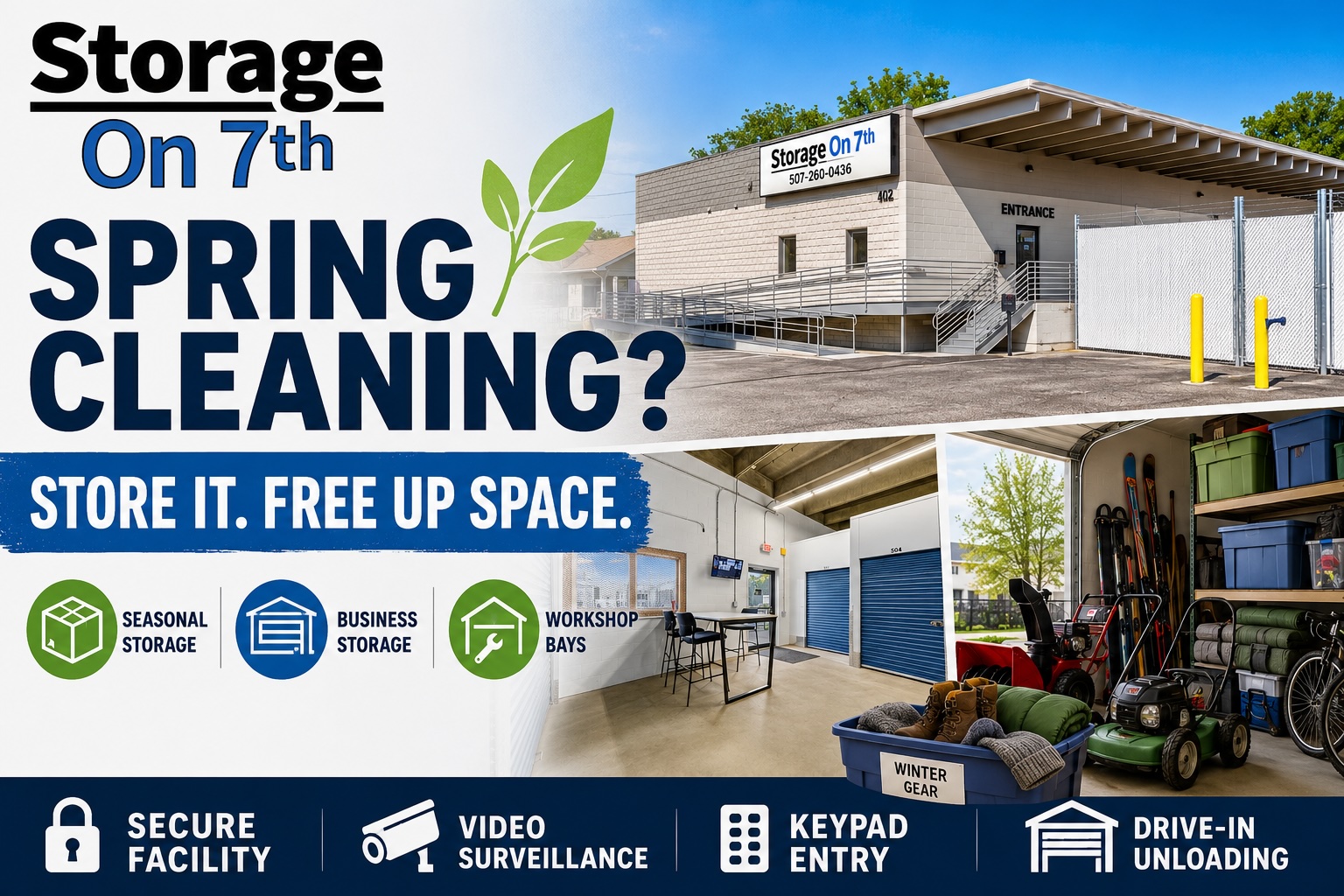
Spring cleaning sounds romantic until you actually start. You open the garage door, look at the snowblower still parked in front of where the patio furniture should be, then realize the basement has somehow grown another stack of boxes since last year. The lawn mower needs to come out. The winter coats need to go somewhere. The kids' outgrown clothes are filling a closet. And nothing has an obvious home.The deeper problem isn't messiness. It's that most homes have a fixed amount of indoor space, and the stuff inside them isn't fixed. It builds up. Seasonal gear cycles in and out. Kids' belongings double every few years. Small business owners who run things out of the house slowly lose the spare bedroom to inventory.This guide is about handling that — sorting it, storing what's worth keeping, and getting back to a house that breathes. I run Storage on 7th in Faribault, Minnesota, and every March through May I watch people work through some version of this exact problem. Below is what tends to work, based on what I've seen for the last six years.
1. Start With One Area, Not the Whole House
The single most common mistake people make with spring cleaning is trying to do the entire house in one weekend. By Sunday night they're exhausted, three rooms are worse than when they started, and the momentum is gone for another year.The better approach is to pick one area — the garage, the basement, the spare bedroom, one closet — and finish it before you start the next. Finishing matters. The satisfaction of seeing one clean, organized space gives you the energy to do the next one. The defeat of three half-finished projects makes you give up entirely.For most Faribault homes, the right starting point is the garage. It's where the winter gear lives, it's where the lawn equipment needs to come out, and it's the easiest place to haul boxes in and out of when you start moving things to storage.
2. The Four-Pile Method
Every item you pick up needs to land in one of four piles:Keep and use regularly. This stuff stays in the house, gets organized properly, and belongs where you'll actually reach for it.Donate or sell. If you haven't used it in over a year and don't have a strong specific reason to keep it, it goes. Most thrift stores in the Faribault area will take furniture, clothes, and household goods. For higher-value stuff, Facebook Marketplace works for a quick local sale.Trash. Broken, worn out, or expired. Be honest with yourself. If the kitchen appliance hasn't worked in two years, you're not going to fix it.Store. Things you'll genuinely use again but don't need access to right now. Seasonal gear, business inventory, sentimental items, kids' things you're saving for the next sibling, family heirlooms in transition.The trap most people fall into is making the "store" pile too big. Storage isn't a way to keep everything forever. It's for the stuff you'll really use again. If you can't picture the specific moment you'll pull something back out, it probably belongs in the donate pile.
3. The Seasonal Gear Swap
This is the most practical reason most Minnesota homeowners use storage in spring. The snowblower needs to come out of the garage so the lawn mower has room. The heavy winter coats are taking up half the entryway closet. The skis and snowboards have been leaning against the wall since March.Things that typically come out of the house in spring:
- Snowblowers and snow shovels
- Skis, snowboards, ice fishing gear
- Heavy winter coats, snow pants, boots
- Holiday decorations
- Space heaters
- Studded tires and tire chains
- Sleds and winter sports gear
Things that typically come back into rotation:
- Lawn mowers, trimmers, leaf blowers
- Patio furniture, grills, outdoor cushions
- Bikes, kayaks, fishing rods
- Camping gear, tents, sleeping bags
- Garden tools and supplies
- Pool equipment
If you've been letting winter gear take up garage and closet space all summer, you're losing roughly six months of indoor space to stuff you don't touch. A small storage unit — a 5x10 or 10x10 — handles a typical household's winter gear and frees up that space for the season you're actually in.
4. Clean Things Before You Store Them
This is the step almost everyone skips, and it's the step that causes the most damage to stored items. Putting dirty, dusty, or damp belongings into a storage unit for six months guarantees they'll come out looking and smelling worse than when they went in.Some practical rules:
- Wash and fully dry all winter clothing before storage. Body oils and dirt on fabric attract pests and set in over time. Damp clothing breeds mildew.
- Clean and dry snow equipment. Snowblowers should be drained of fuel (or treated with fuel stabilizer) and have the deck wiped down. Salt residue rusts metal.
- Vacuum and air out upholstered items. Patio cushions especially.
- Wipe down sports equipment. Boots, helmets, and gloves all benefit from a quick clean before they sit unused for half a year.
- Boxes and bins should be sealed but not airtight. Some air circulation prevents condensation; complete sealing can trap moisture.
The five minutes of cleaning per item pays off six months later when you pull them out and they're still usable.
5. Climate Matters Over a Six-Month Storage Period
For short-term storage — a few weeks during a move — temperature and humidity don't have much time to do damage. For the kind of seasonal storage we're talking about here, where items sit for six to eight months across a full Minnesota summer, climate matters a lot.Non-climate-controlled storage in a Minnesota summer regularly hits 90°F+ with high humidity. That's brutal on:
- Anything leather (jackets, boots, bags) — dries out and cracks
- Anything wood (skis, furniture, instruments) — warps and loosens at the joints
- Anything electronic (space heaters, holiday lights, audio gear) — components degrade
- Anything fabric (coats, cushions, clothing) — absorbs humidity, breeds mildew
If you're storing seasonal gear that you actually want to use again, climate-controlled storage protects it through the off-season. If you're only storing low-value tools or rough outdoor equipment, non-climate-controlled is fine and you should pay less. We've talked to plenty of customers and pointed them to a cheaper non-climate option down the road when that was the honest call for what they were storing.
6. Small Business Inventory and the Spring Rotation
A lot of small businesses run on seasonal cycles. The spring shift looks different depending on the business, but the pattern is the same: stuff that was front-and-center six months ago needs to move out of the way for what's selling now.
- E-commerce sellers rotate winter SKUs out and summer SKUs in
- Trades and contractors swap seasonal equipment (snow removal gear out, landscaping or HVAC gear in)
- Event-based businesses put away holiday and winter event supplies, pull out wedding-season and outdoor-event supplies
- Retail and craft businesses clear out winter inventory remainders and shift to spring and summer stock
- Home-based businesses that have slowly taken over the garage or spare bedroom usually need to consolidate somewhere
The economics are usually obvious once you do the math. A small commercial storage unit is dramatically cheaper than renting commercial retail or warehouse space, and gets the inventory out of the house so your home is a home again.If you're running a business out of the house, the spring reset is also a good time to think about whether storing inventory at home is still working. Most homeowner insurance policies don't cover business inventory, many residential leases don't allow it, and for most family setups, having boxes of product stacked in the living room wears thin fast.
7. Workshop Bays for Project Season
Spring is also when a lot of people get the itch to start something. A car restoration that's been parked in the driveway under a tarp all winter. A woodworking project the spouse will not allow another inch of garage space for. A motorcycle or boat that needs a heated, dry place to sit while it gets put back together.For folks in that situation, a workshop bay is a different animal than a regular storage unit. Our workshop spaces in Faribault have heat, full ceiling height, a 10x12 overhead garage door, and electrical for tools. You can drive a vehicle in, close the door behind you, and actually work on it — not just stash it.This comes up often enough each spring that it's worth mentioning. If your spring cleaning surfaces a "project I keep meaning to get to but have no room for," a workshop bay can be the answer for a few months rather than a full year.
8. What Not to Store, Ever
Spring cleaning produces a lot of "I'll just throw this in storage for now" thinking. Some categories really shouldn't go in:
- Food, including pet food. Attracts pests, period.
- Liquids that can freeze or leak. Paint, cleaning supplies, propane.
- Anything flammable or explosive. Gasoline, lighter fluid, ammunition. Most storage agreements prohibit these for good reason.
- Wet items. Anything not fully dried before going in becomes a mold problem.
- Live plants or anything organic that'll decompose.
- Items you'll need access to weekly. If you're going to drive to storage every week to grab something, it doesn't really belong there. Find a way to keep it at home.
That last one is worth thinking about hard. The whole point of storage is to free up indoor space for the stuff you use daily. If you store the things you actually use every week, you've just added a commute.
9. A Spring Cleaning and Storage Checklist
Before you start hauling things to a unit, run through this:
- Have I sorted everything into keep, donate, trash, or store?
- Is the "store" pile actually things I'll use again, or is it the stuff I can't bring myself to part with?
- Have I cleaned and dried everything that's going into storage?
- Have I labeled boxes clearly enough that I'll know what's in them in October?
- Am I using sealable bins for anything fabric or paper, not just cardboard?
- Have I picked a unit size that fits without being twice as large as I need?
- Have I asked whether the unit is climate-controlled, and is that the right call for what I'm storing?
If you can answer yes to those, you're in good shape.
A Final Word from Faribault
Spring cleaning is really about resetting the relationship between your house and your stuff. Most of us accumulate without realizing it. The garage slowly fills, the closets pack tighter, the spare bedroom turns into a storage room, and then one day in April you can't park inside anymore and something has to give.The two things that actually solve it are honest sorting and somewhere to put what you want to keep but don't currently need. Both take a weekend or two. Both pay off for the next twelve months.If you're in or near Faribault, Minnesota and need spring storage — for winter gear, seasonal equipment, business inventory, a project bay, or anything in between — we have climate-controlled units from 5x5 up to 16x36 at Storage on 7th, plus workshop bays for the projects that need a place to land. Indoor halls, keypad entry, security cameras throughout, and drive-in unloading so you don't have to haul boxes through rain or wind to get them in.Come take a look, or just call and tell us what you're trying to clear out. We've helped a lot of people in the same situation, and we'd rather get you into the right size for the right amount of time than oversell you on something you don't need.
The 7th Street Journal