.png)
Indoor vs. Outdoor Vehicle Storage: Which Is Right for Your RV, Boat, or Car?
Indoor vs. Outdoor Vehicle Storage: Which Is Right for Your RV, Boat, or Car?
Ryan E.
March 3rd, 2024
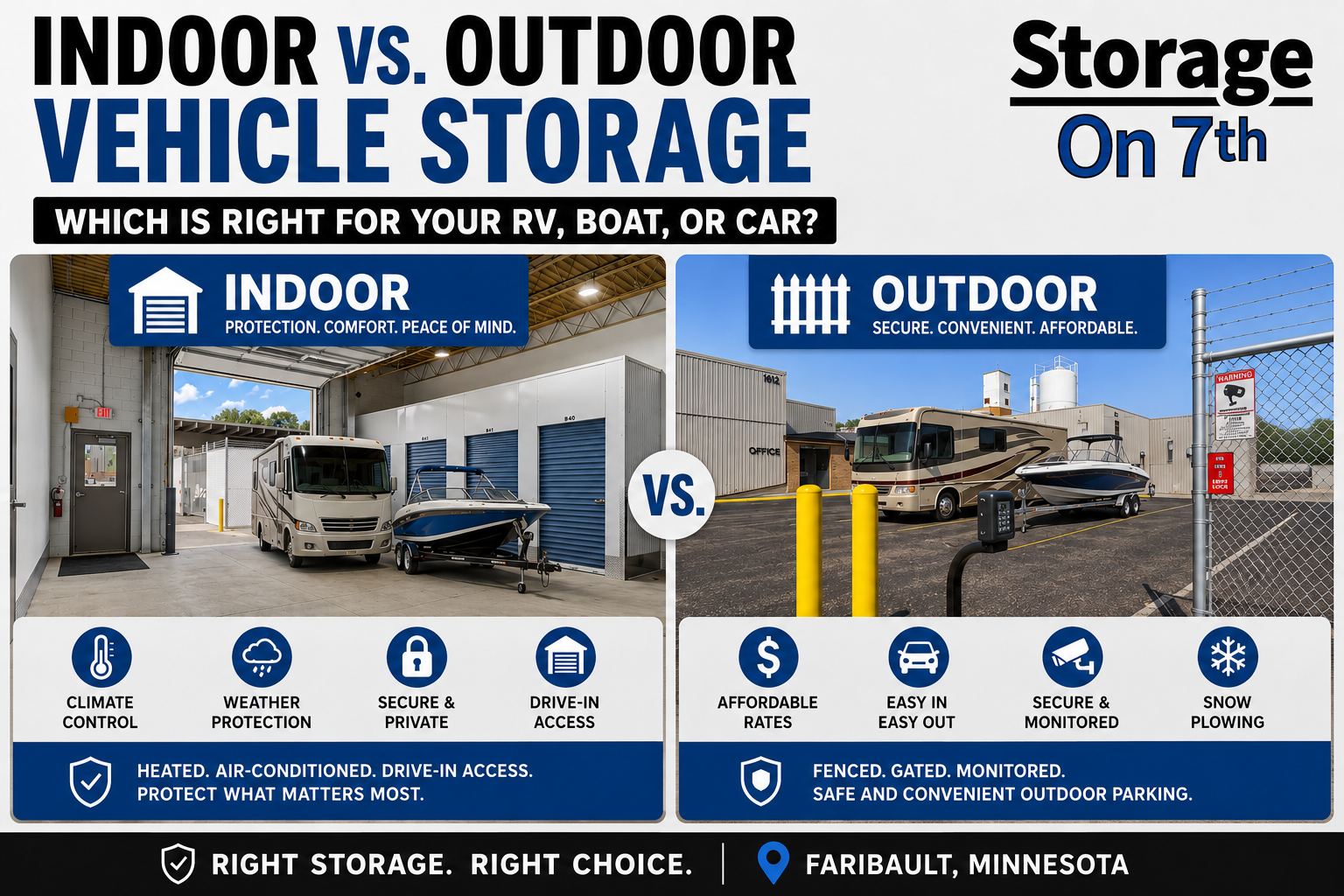
If you've decided you need to store a vehicle somewhere other than your driveway, the next decision is whether to go indoor or outdoor. Most facilities offer both, and the cost difference is significant — indoor typically runs four to six times the price of outdoor for the same footprint. That price gap is real, and the right answer depends entirely on what you're storing, how long you're storing it, and how much you care about its condition when you come back to it. I run Storage on 7th in Faribault, Minnesota, where we offer both indoor and outdoor vehicle storage. Below is the honest comparison I give people when they're deciding between the two — including the cases where I'll actively talk someone out of paying for indoor when they don't need it.
1. The Price Difference Up Front
Pricing varies by region and facility, but here's a useful range to anchor on. At Storage on 7th:
- Outdoor vehicle storage: starts around $60/month for a 10x20 spot and runs up to about $100/month for a 40-foot spot
- Indoor vehicle storage: runs about $325/month for a comparable 10x20 unit
That's roughly a 5x premium for indoor. Over the course of a year, you're looking at $720 outdoor vs. about $3,900 indoor for the same-sized vehicle. Over five years, the gap is more than $15,000. That's not a small difference, and it deserves serious consideration before you default to indoor "just to be safe."
2. What Indoor Storage Actually Gives You That Outdoor Doesn't
The premium gets you several real protections: Climate control. Indoor units are heated in winter and air-conditioned in summer. Your vehicle isn't subjected to freeze-thaw cycles, deep cold that strains batteries and fluids, summer heat that degrades interiors and rubber, or humidity swings that promote rust. Total weather protection. No rain, no snow, no hail, no sun, no wind-blown debris, no salt spray during winter road treatment. Your vehicle stays dry and clean. Better pest protection. Most quality outdoor lots have pest control (ours does), but indoor storage adds another layer — pests have to get inside the building first. Rodents in engine bays chewing through wiring is one of the most expensive problems in vehicle storage, and indoor reduces that risk significantly. Cleaner vehicle, every time. When you come to use your vehicle, you're not scraping snow, sweeping pollen off the hood, or wiping bird droppings off the paint. You walk in, the vehicle is exactly how you left it. Drive-in convenience. Most indoor vehicle storage units allow you to drive your vehicle directly into the building, close the overhead door behind you, and unload or work on it in a heated, dry space. That's a meaningful quality-of-life difference, especially in Minnesota winters.
3. What Outdoor Storage Gives You
The case for outdoor is mostly economic, but it's not just "cheap." For many vehicles, outdoor is genuinely sufficient:
- A fraction of the cost. Saving $200+ a month adds up to thousands of dollars a year that you could spend on actually using your vehicle, or maintaining it, or anything else.
- Easy in, easy out. Outdoor lots typically have wider drive aisles than indoor facilities, so backing in a long trailer or maneuvering an RV is often easier outside.
- Plenty of space for larger vehicles. Outdoor spots commonly accommodate 40-50 foot vehicles. Indoor units that big are rarer and significantly more expensive.
If your vehicle is built to handle weather (which most are), outdoor storage at a well-secured, well-maintained lot does its job.
4. Which Is Right for Your Vehicle Type
Here's the breakdown by vehicle category: Standard cars and trucks (daily drivers, second cars, snowbird vehicles)Outdoor is almost always fine. These vehicles are designed to live outside year-round. The only exception is if you're storing through a brutal winter and want easier cold-weather access — indoor saves you the snow-scraping and battery struggles. Boats on trailersOutdoor works well for most boats. They're built for water and weather. Worth considering indoor if: you have a high-end fishing boat with a lot of electronics, your boat has a custom paint job or wrap, or you keep the boat for many years and want it to look new. Standard RVs and travel trailersOutdoor works for most. The premium for indoor is significant relative to RV maintenance costs, and most RVs are designed to handle outdoor exposure. Worth considering indoor if: your RV is high-end (Class A motorhome, premium fifth-wheel), you're trying to preserve resale value, or you don't want to deal with cover removal and inspection every spring. Classic cars, restored vehicles, show carsIndoor is almost always worth the premium. Outdoor exposure — even at a clean, secured lot — accelerates paint fade, rust development, and interior degradation in ways you can't fully reverse. If you've spent serious money restoring a vehicle, indoor protects that investment. MotorcyclesIndoor is usually worth it for most motorcycles, partly because storage costs less than for a full vehicle, and partly because motorcycles are particularly vulnerable to rain, condensation, and theft. Many tenants who store motorcycles indoor end up parking them in a 5x10 or 10x10 indoor unit rather than dedicated vehicle storage. High-end specialty vehiclesConvertibles, exotic cars, vintage trucks, custom-built vehicles — indoor is the right answer. The math doesn't work otherwise.
5. Climate and Weather Considerations (Especially in Minnesota)
In a place like Faribault, the climate factor matters more than it would in, say, Arizona. Winter cold. Subzero temperatures kill batteries, thicken fluids, and stress every rubber and plastic component on a vehicle. Outdoor-stored vehicles need extra prep — battery disconnect or trickle charger, fuel stabilizer, thoroughly winterized water systems for RVs. Indoor storage eliminates most of that prep work. Snow accumulation. Outdoor vehicles get buried. Even at a facility that plows (we do), individual vehicles can be snowed under, and you'll need to clear them off before moving them. Indoor storage means you can pull your vehicle out year-round without thinking about snow. Spring melt and ice damage. Standing water from snowmelt, ice formation under tires, and the general mess of late-winter parking lots can do real damage. Indoor avoids all of it. Summer sun and heat. Less of a concern in Minnesota than in southern states, but still relevant. UV exposure fades paint, degrades dashboards and seats, and ages exterior plastics over time. Indoor preserves the cosmetic condition of your vehicle indefinitely. Hail. Minnesota gets occasional severe storms with damaging hail. A single bad hailstorm can do thousands of dollars in damage to an outdoor-stored vehicle. Indoor eliminates that risk. If you're storing a vehicle through Minnesota winters specifically, the case for indoor is stronger than it would be in a milder climate.
6. Security Considerations
A common misconception is that indoor storage is dramatically more secure than outdoor. The truth is more nuanced. A well-run outdoor lot — fully fenced, gated with keypad entry, monitored by cameras, well-lit — is very secure. Vehicles aren't easy targets even outdoors when the perimeter is locked down and watched. Indoor adds an extra layer because pests, thieves, and weather all have to get through a building before they can get to your vehicle. That extra barrier is worth something, but it's not as dramatic a difference as people sometimes think. The real security question to ask isn't "indoor or outdoor?" It's "is this facility well-secured in either format?" A poorly secured indoor facility is worse than a well-secured outdoor lot.
7. Access and Convenience
This is where indoor storage often wins, even for people who don't strictly need climate control. Indoor pros:
- Use your vehicle in any weather without scraping or shoveling
- Load and unload in a heated, dry space
- Cleaner vehicle every time you come to use it
- Often easier on insurance claims if something happens to the vehicle
Outdoor pros:
- Easier to maneuver larger vehicles in and out
- Often longer access hours (24/7 at many facilities, including ours by request)
- More straightforward to back in a trailer or hitch up
If you use your vehicle frequently and convenience matters more than maximum protection, indoor is often worth the cost. If your vehicle sits in storage for months at a time and you only access it a few times a year, the convenience difference matters less.
8. The Math: When the Premium Is Worth It
Here's a simple framework. Indoor storage adds roughly $250 a month over outdoor at a comparable facility. That's $3,000 a year. Indoor is worth that premium if:
- The vehicle is worth $40,000+ and you want to preserve its value
- The vehicle has paint, interior, or electronics you want to keep showroom-fresh
- You'll use the vehicle frequently year-round and value the convenience
- You're storing it for many years and the cumulative weather exposure adds up
- Insurance discounts or peace of mind justify the difference
Indoor probably isn't worth that premium if:
- The vehicle is a standard car, truck, or trailer that lives outside anyway
- You're only storing it for a season (a few months)
- The vehicle is worth less than the difference would total over its expected lifespan
- You're already committed to thorough winterizing and care anyway
Run the math on your specific vehicle. If the difference between indoor and outdoor over the time you'll store the vehicle exceeds, say, 10% of the vehicle's value, outdoor is probably the better call. If it's less than that, indoor often pays for itself in preserved value alone.
9. A Common Scenario
The classic case I see goes like this: Someone buys a classic car, restores it over a few years, sinks $30,000+ into it, and wants to store it through Minnesota winters when they can't drive it. They look at indoor pricing and think it's expensive. So they choose outdoor to "save money." Then they pull the car out in May and find condensation damage, paint that's noticeably duller than when they parked it, and a battery that wasn't strong enough to handle the cold even with a trickle charger. The "savings" cost them more than they paid in storage to fix. For that kind of vehicle, the math is unambiguous. Indoor storage isn't an expense — it's part of the cost of owning the vehicle. The opposite scenario: someone's storing a 12-year-old fishing boat through the off-season. They look at outdoor and think it might be too exposed. They go indoor and pay $325 a month. By spring, they realize they've spent $1,300 to store a boat worth $4,000 — a 30% storage-to-value ratio that doesn't make economic sense for a vehicle that lives in water for half its life anyway. For most everyday boats, outdoor is the right call.
10. A Quick Decision Checklist
Before you commit to indoor or outdoor, run through this:
- What's the realistic value of the vehicle today?
- How long do I plan to store it (months, years, indefinitely)?
- Does the vehicle have paint, interior, or electronics worth protecting from weather?
- Will I use it frequently year-round, or only seasonally?
- Am I willing to do the prep work (winterizing, covers, battery maintenance) that outdoor storage requires?
- What's the difference in storage cost over the time I'll need it, and is that more or less than the value I'd lose to outdoor exposure?
If the answers point toward "valuable, long-term, paint matters, frequently accessed, don't want to maintain it constantly," indoor is worth the cost. If they point toward "standard vehicle, short-term, designed for weather, low-maintenance," outdoor saves you real money without much downside.
A Final Word from Faribault
Both indoor and outdoor vehicle storage have a place. The mistake is defaulting to one without thinking about what your specific vehicle and situation actually require. If you're in or near Faribault, Minnesota and want to look at both options, we offer indoor vehicle storage starting at $325/month for a 10x20 unit (climate-controlled, drive-in access, secure indoor environment), and outdoor storage from $60/month for a standard car spot up to about $100/month for a large camper (asphalt lot with painted lines, fully fenced perimeter with barbed wire, keypad entry, motion lighting, security cameras, pest control, and snow plowing all winter). Stop by, take a look at both, and we'll help you figure out which one actually makes sense for what you're storing. If outdoor is the right call for your vehicle, we'll tell you that — even though indoor would be more profitable for us. The right answer is the one that fits your vehicle, not the one that costs more.
The 7th Street Journal