.png)
Climate-Controlled vs. Non-Climate-Controlled Storage: Which Do You Really Need?
Climate-Controlled vs. Non-Climate-Controlled Storage: Which Do You Really Need?
Ryan E.
January 20th, 2023
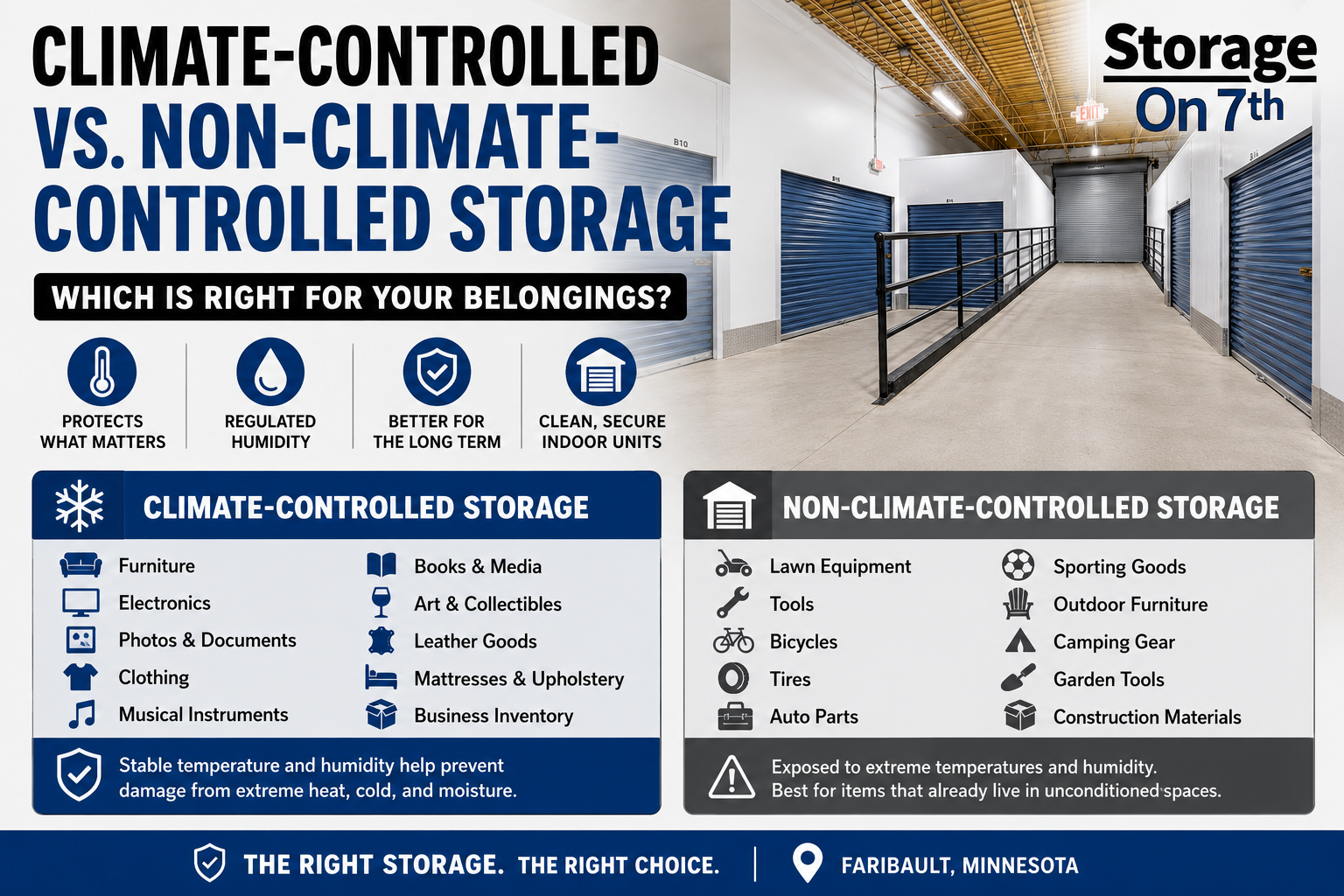
Walk into any storage shopping process and you'll quickly hit a fork in the road: climate-controlled units or non-climate-controlled? The climate-controlled units are usually 25 to 50 percent more expensive, and the facility website will list a lot of reasons why they're worth the extra money. Whether that's actually true for your specific situation is a different question. The honest answer is that climate control matters a lot for some belongings and not at all for others. Paying for it on the wrong stuff is a waste of money. Not paying for it on the right stuff can cost you many times more than you saved. I run Storage on 7th in Faribault, Minnesota, and we only offer climate-controlled units. That's a deliberate choice, and I'll explain why later in the post. But first, here's how to think about which type of storage you actually need.
1. What Climate-Controlled Storage Actually Is
Climate-controlled storage means the unit is kept in a regulated temperature range year-round — typically somewhere between 55°F and 80°F — and often with humidity controlled to prevent extremes. In Minnesota terms, that means your unit doesn't drop below freezing in January and doesn't bake in July heat. It also means the air inside isn't swinging from bone-dry winter conditions to muggy summer humidity. Non-climate-controlled storage, sometimes called "drive-up" storage or outdoor sheds, has none of that regulation. The inside of the unit tracks closely with the outside temperature and humidity. In Minnesota, that means real extremes: -20°F in winter and 90°F+ with high humidity in summer.
2. What Climate Control Actually Protects Against
The wear and tear on stored items isn't usually from a single dramatic event. It's from cumulative exposure to: Freeze-thaw cycles. When temperatures swing back and forth across freezing, materials expand and contract repeatedly. This destroys glued joints in furniture, cracks plastics, and can warp wood over time. Extreme cold. Below-freezing temperatures damage anything water-based (paint, certain adhesives, batteries, electronics), can crack vinyl records and old photos, and make many plastics brittle. Extreme heat. High summer temperatures warp records, melt candles, degrade electronics, dry out leather, and accelerate the breakdown of glues and finishes. Humidity. This is the silent killer. High humidity promotes mold and mildew on fabric, paper, and wood. It causes metal to rust. It makes upholstery smell musty. It encourages pests. Low humidity in winter, on the other hand, can crack leather and dry out wood furniture. Condensation. When temperature changes happen quickly, moisture condenses on cool surfaces. This is how electronics get internally damaged, how paintings warp, and how clean items end up with rust spots. A climate-controlled unit smooths out all of this. The temperature stays moderate. The humidity stays in a reasonable range. Your stuff sits in conditions roughly similar to what a normal indoor room provides.
3. Items That Genuinely Need Climate Control
If you're storing any of the following, climate control is worth the premium:
- Wood furniture (especially antiques, veneered pieces, or anything you care about long-term)
- Leather goods (couches, jackets, bags — leather cracks and dries in extreme conditions)
- Electronics (TVs, computers, audio equipment, gaming systems)
- Musical instruments (especially wood instruments like pianos, guitars, violins)
- Photos, photo albums, and important documents
- Artwork, paintings, framed pieces
- Books and paper records
- Vinyl records and media
- Clothing you actually plan to wear again (especially wool, silk, leather, anything dry-clean-only)
- Mattresses and upholstered furniture
- Wine collections
- Anything with adhesive, glue, or laminate construction (most modern furniture)
- Stored business inventory (especially anything with packaging, labels, or electronics)
- Sentimental items that can't be replaced
The common thread: anything that absorbs moisture, anything with delicate finishes, anything sensitive to temperature, and anything you'd be upset to lose.
4. Items That Don't Need Climate Control
If you're storing only the following types of items, non-climate-controlled storage is genuinely fine and you should pay less:
- Lawn equipment (mowers, trimmers, snow blowers)
- Hand tools and power tools
- Bicycles
- Sporting goods (most of them)
- Plastic outdoor furniture
- Camping gear
- Auto parts
- Tires
- Pool equipment
- Construction materials
- Garden tools and supplies
The common thread here: stuff that already lives in your garage or shed at home. If you'd keep it outdoors or in an unconditioned space at your house, you don't need to pay extra to climate-control it in storage. When tenants come to us looking for storage and tell me they're only storing this kind of "garage stuff," I'll often recommend they look at a non-climate-controlled facility instead. They'll get a better price, and the storage conditions don't matter for what they're storing. That's the honest call.
5. The Price Difference
Climate-controlled storage typically costs 25 to 50 percent more than non-climate-controlled storage at facilities that offer both. Some places have an even bigger gap. At our facility, we don't have an internal comparison because we only offer climate-controlled. But here's a rough sense of what you'd see across the market:
- A 10x10 non-climate-controlled unit might run $75-$100 a month
- A 10x10 climate-controlled unit might run $115-$160 a month
That's a $40-$60 monthly premium, or $480-$720 over a year. Whether that's worth it depends entirely on what you're storing. If you're storing wooden bedroom furniture, a leather couch, electronics, and photo albums, climate control protects thousands of dollars of belongings. Pay it. If you're storing a snowblower, garden tools, and extra tires, climate control is wasted money. Don't pay it.
6. The Minnesota Factor
Climate control matters more in some climates than others. In a place like Faribault, the case for it is stronger than average. Minnesota winters routinely hit -20°F. Minnesota summers regularly hit 90°F+ with significant humidity from nearby lakes and rivers. That's a 110°F range from coldest day to hottest day, plus humidity swings that go from desert-dry in winter to muggy in summer. That kind of seasonal variation is exactly what destroys stored belongings over time. A wood dresser stored through one Minnesota winter in a non-climate-controlled outdoor shed will likely come out with at least some warping, drying, or joint loosening. Stored through five years of those conditions, it can become structurally compromised. If you live somewhere with mild seasons — say, the Pacific Northwest or coastal California — climate control matters less, because the natural conditions never get extreme. In Minnesota, the extremes are part of the deal.
7. The Humidity Trap Most People Forget
Temperature gets all the attention, but humidity is what causes most stored-item damage. Non-climate-controlled storage in Minnesota often hits high humidity in summer months. Even if the unit isn't sweltering, the moisture in the air gets absorbed by anything porous — fabric, paper, wood, cardboard boxes. Combined with limited ventilation, that creates perfect conditions for mold and mildew. Mold doesn't just smell bad. It permanently stains fabric. It eats into wood and paper. Once it gets a foothold on stored items, it's nearly impossible to remove without throwing the item out. Climate control doesn't just regulate temperature — it also regulates humidity, which is often the more important factor for long-term storage.
8. When Non-Climate-Controlled Actually Makes Sense
To make sure this post is honest rather than a sales pitch for climate control: there are real situations where non-climate-controlled storage is the right answer.
- You're only storing items that already live in unconditioned spaces (garage stuff, outdoor equipment, tools)
- You're storing for a very short period (a few weeks, not months) and the seasonal extremes won't really hit
- You're storing low-value items where the cost of climate control over time exceeds what the items are worth
- You're storing inventory or supplies that aren't sensitive to temperature or humidity (think: bulk packaging materials, certain construction supplies)
In those cases, paying the climate-control premium is genuinely wasted money. A drive-up storage shed at a budget facility is fine.
9. Why We Only Offer Climate-Controlled Units
At Storage on 7th, we made a deliberate choice to only offer climate-controlled storage. The reason is simple: we wanted to focus on doing one thing really well, rather than trying to be everything to everyone. Most people who genuinely value their stored belongings end up wanting climate control. They've usually had a bad experience with a non-climate-controlled facility — a piece of furniture ruined, a box of family photos discovered moldy years later, electronics that mysteriously stopped working after a season in storage. Once you've been through that, you don't want to risk it again. By focusing on climate-controlled units, we can build a facility that genuinely serves those tenants well. Heated and cooled buildings, sealed construction to keep pests out, better security because the building is locked down rather than open-air, and indoor units that stay cleaner than any outdoor shed. For the smaller subset of customers who just need to store garage stuff and don't need climate control, there are other facilities in the area that specialize in that. We'll be honest about pointing them in that direction rather than upselling them on what we offer.
10. A Decision Framework
Before you commit to climate-controlled or non-climate-controlled, run through this:
Choose climate-controlled if:
- You're storing furniture, electronics, clothing, photos, books, or anything that lives indoors at home
- You're storing for more than a few weeks
- The total value of what you're storing exceeds the cost of climate control over the time you'll need it (usually a low bar to clear)
- You're in a climate with significant temperature or humidity swings
- You care about the stored items long-term and don't want to risk damage
Choose non-climate-controlled if:
- You're storing only "garage stuff" — tools, equipment, items that already live in unconditioned spaces
- You're storing low-value items where the premium isn't justified
- You need short-term storage (a few weeks) and the seasonal extremes won't fully hit
- You're confident the items can handle temperature and humidity swings
If you're not sure, err on the side of climate control. The cost premium is typically modest compared to the cost of replacing a single damaged piece of furniture or losing irreplaceable items.
A Final Word from Faribault
Climate control isn't a luxury feature. For most household belongings, especially in a climate like Minnesota, it's the difference between belongings that come out of storage in the condition they went in and belongings that quietly degrade over time. If you're in or near Faribault, Minnesota and storing furniture, electronics, clothing, family items, or anything you actually care about, climate-controlled storage is what you want. We offer climate-controlled units from 5x5 up to 16x36, all in heated and cooled buildings with controlled humidity year-round. If you're storing only garage equipment and tools, you might genuinely save money at a non-climate-controlled facility, and we'll tell you that. We'd rather you spend the right amount on the right kind of storage for what you actually have. Either way, think about what you're storing before you choose. The cheapest unit isn't always the right unit, and the most expensive unit isn't either. The right unit is the one matched to what you're putting inside it.
The 7th Street Journal